A provider incident becomes your incident
When a cloud or hosting provider is disrupted, customers can lose a business service even when their own environment was not the initial point of compromise. An outage does not automatically establish that information has been stolen, and early incident reports may change. For planning, the useful question is which dependencies would remain available, who could make a recovery decision and what evidence supports the available options. Start with those arrangements before relying on an unverified incident comparison.
List what each provider runs for you
Start with an inventory that goes beyond the main contract. For each provider, record the hosting, networking, identity, backup, monitoring and SaaS services your business uses. Ask about subcontracted services and which dependencies the provider can confirm. Check for dependencies absent from the main contract, such as name resolution, a backup target or an authentication platform. For each item, note the business activity that relies on it and the person who owns the relationship.
Separate shared responsibility from assumptions
Cloud responsibilities differ by service model. Microsoft’s shared responsibility guidance explains that customers retain responsibility for areas such as data and identities. Check this against what you actually run rather than relying on a general statement. For each service, write down who manages access, configuration, backup, monitoring and recovery. A blank cell in that table is a finding to resolve, not an item to ignore.
Ask what recovery looks like if the provider cannot help
Consider the case where the provider cannot supply the normal support or administrative tools. Ask whether a usable export or separately protected copy is available, including when the primary service is inaccessible. Identify where it could be restored and the prerequisites for doing so. Identify whether an alternative environment exists, even a reduced one, and who can authorize switching to it. Review contract terms on notification, service credits and exit assistance, and involve procurement or legal advisers for the contractual questions. Be realistic: some dependencies cannot be replaced quickly, and the plan should say so.
Check notification and escalation routes
Confirm how you would learn about an incident at the provider, who contacts you and whether that route works if your normal email or collaboration tools are affected. Keep escalation contacts and out-of-band communication details where they can be reached during an outage. Record who inside your organization decides when to invoke a fallback and who communicates with staff and customers.
Test the dependency, not just the provider
A discussion-based exercise can walk teams through a provider outage without disrupting live services. Pick one critical service and ask what stops, what continues, which manual workarounds are acceptable and who approves them. The business owners, not only the technology team, should answer these questions. The multi-site logistics article describes how to review fallback arrangements and reconcile delayed records afterward. The managed IT outsourcing guide also explains why access, documentation and transition responsibilities belong in the initial agreement.
Start with one critical service
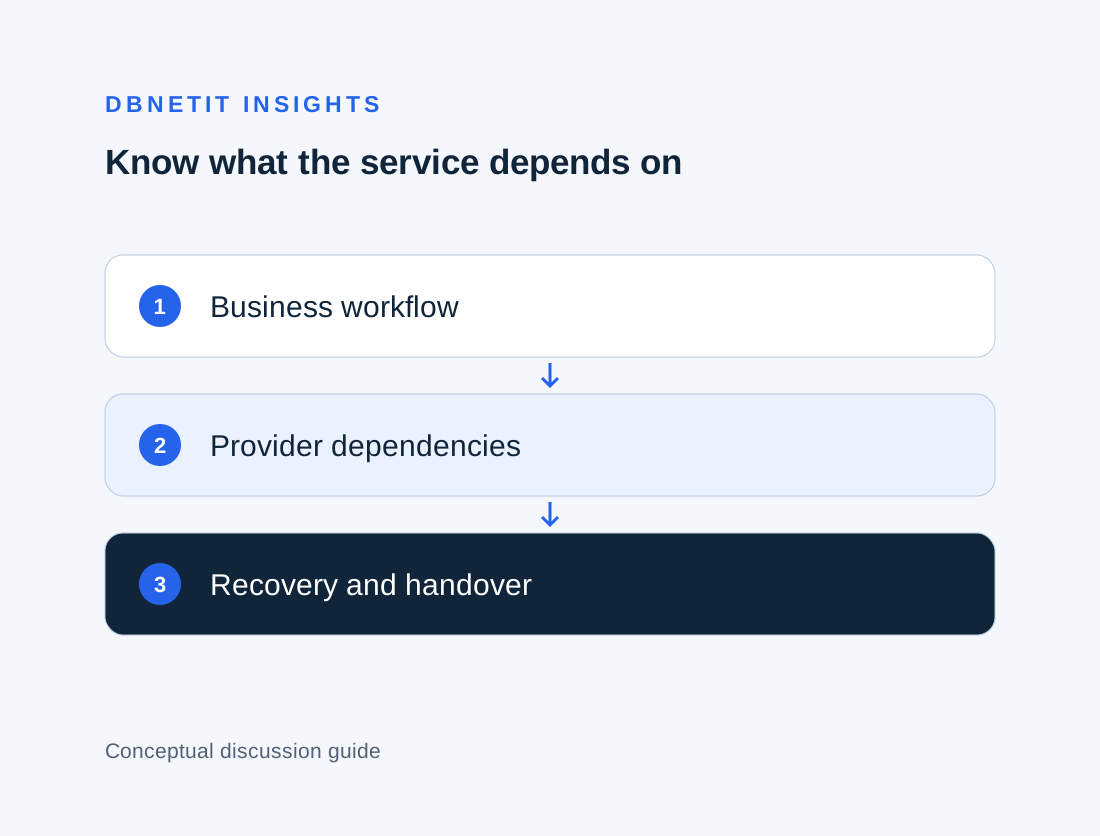
Choose a service the business cannot operate without and trace every provider it depends on. Record the owner, recovery path, contact route and unanswered questions for each. Prioritize the gaps with the greatest business impact and assign owners and dates. DBNETIT’s Cloud & Modern Workplace service can help map workload dependencies and handover responsibilities, and IT & Managed Services can support recovery planning and documentation.